Showing posts with label Invasive Species. Show all posts

Monday, May 21, 2012

Red Card for Foxes in Kellerberrin


A team of landholders from north Kellerberrin has claimed victory in a local feral pest hunt.
 
The Red Card for the Red Fox program aims to coordinate community action for better control of feral foxes, cats and rabbits, and has been underway across the central Wheatbelt during March and April.


The shoot, organised by the Kellerberrin Shire, was held in March and April, over two weekends.
 
Wheatbelt NRM sponsored the Highest Points Trophy and the community BBQ as part of the Caring for Our Country Program. Wheatbelt NRM’s Regional Landcare Facilitator Mick Davis said eight teams competed from around Kellerberrin district.

“Because of the combined effort, 328 foxes were culled along with 22 cats and 72 rabbits,” Mick said. 


The winning team was North Kellerberrin, made up of Andrew Cox (North Kellerberrin), Brian Wilkins (Doodlakine), Bryce Wilkins (North Kellerberrin) and Ben Chandler (South Doodlakine), who tallied 61 foxes and four cats.

“These events are a more effective way of controlling feral animals,” Mick Davis said. "Foxes and cats prey on our native wildlife, which often includes threatened or rare species"

"Without active feral control like the Red Card program, species like the Black-flanked Rock Wallaby, which live in the Kellerberrin District would already be extinct"

Photo by Phil Lewis, WWF
Landholder Ben Chandler from south Doodlakine, who was part of the winning team, said the event helped get more people involved.

“It makes it easy, usually if you go out fox shooting it’s only a couple of hours by yourself,” Ben Chandler said. “But when you have an event like the Red Card program, it gives you a motivation to all get together.

“Otherwise you would never get together and shoot so many foxes.”

If you are interested in becomming involved in the Red Card for the Red Fox program, contact Mick on 0428 969 096 or mdavis@wheatbeltnrm.org.au

Or, visit the Red Card website at  http://www.redcard.net.au/

Wednesday, December 7, 2011

Frog Watch in Quairading

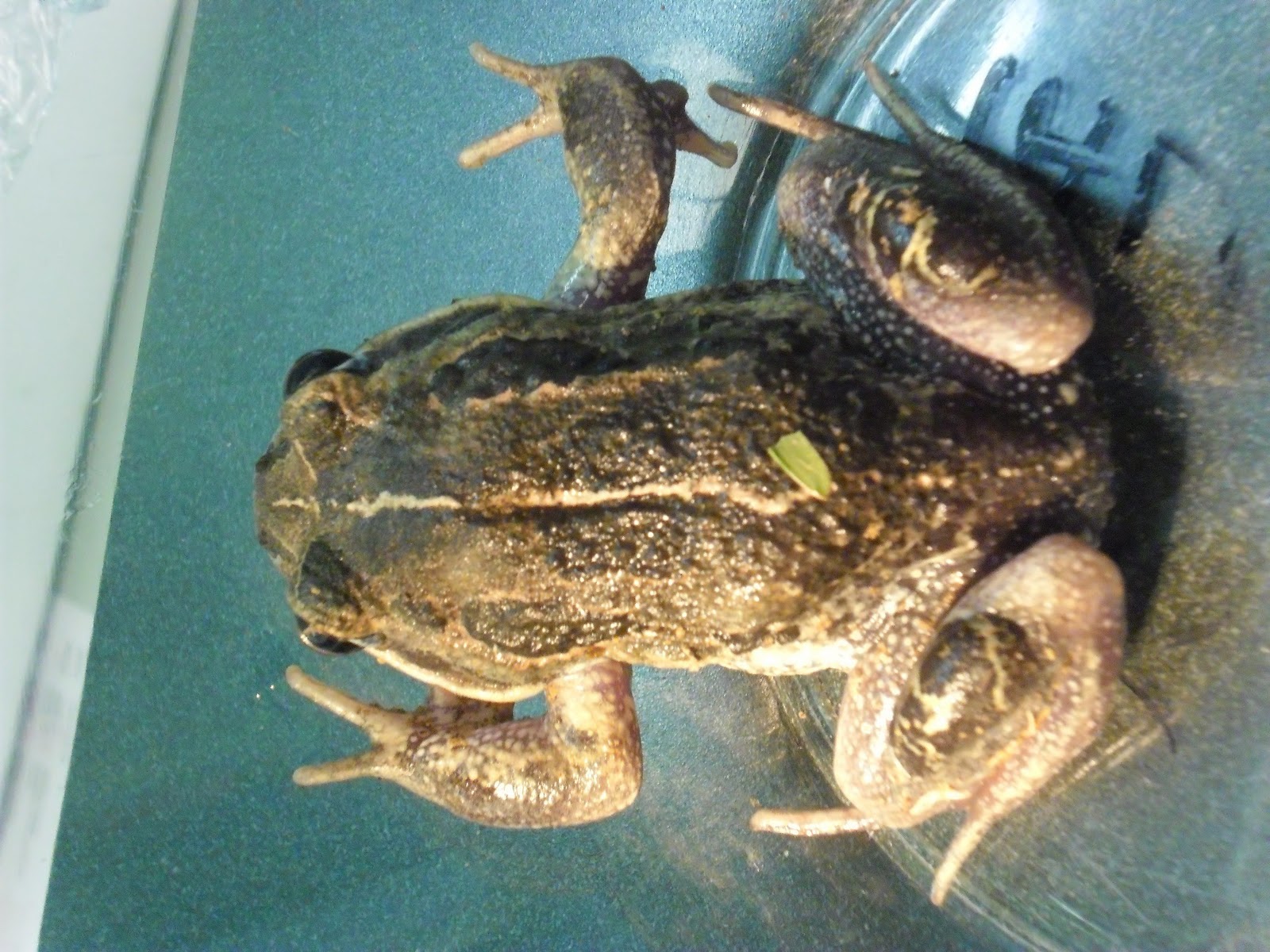
After a bit of wet weather recently, a couple of sharp-eyed residents from Quairading sent these pictures of a frog to the Shire's Environmental Officer earlier this month, concerned that it may have been an invasive Cane Toad.


Luckily it was identified as a Western Banjo, or Pobblebonk, Frog (Limnodynastes dorsalis) from the pale 'dorsal' line down the frogs back. These frog are most common in permanent and temporary water including farm dams, swamps, wetlands and streams, but can also be found in backyards across the entire south-west.


From Frog Watch Website


Western Banjo Frogs and Cane Toads  are commonly confused with each other, so if you see someting similar and you are not sure what it is, take a photo and/or report it to your local authorities so they can help with an identififaction. Your vigilance could make a difference.

In comparison, the Cane Toad (Bufo marinus) is much larger, more warty and does not have a pale 'dorsal' line down its back.

G Millen © Australian Museum
H Ehmann ©  Australian Museum

The distribution of the Cane Toad is still being resolved in Australia - the map below shows past, current and predicted range across the nation.

Distribution map for Cane Toads in Australia - note SW WA prediction

An awareness of what Cane Toads look like is one of the biggest assets our community has in the fight against this tropical invader. Although WA is almost Cane Toad free, there is a large potential for this invasive species to impact on our biological and agricultural values.

So, hats-off to the couple from Quairading who wanted to be sure their frog was not a Cane Toad - a little bit of effort can go a long way!
For more info on Wheatbelt frogs you may want to visit the Frog Watch website.

For more info Cane Toads you may want to visit the Toad Busters website.

Email info@wheatbeltnrm.org.au if you want any additional information.