Wednesday, December 7, 2011

Frog Watch in Quairading

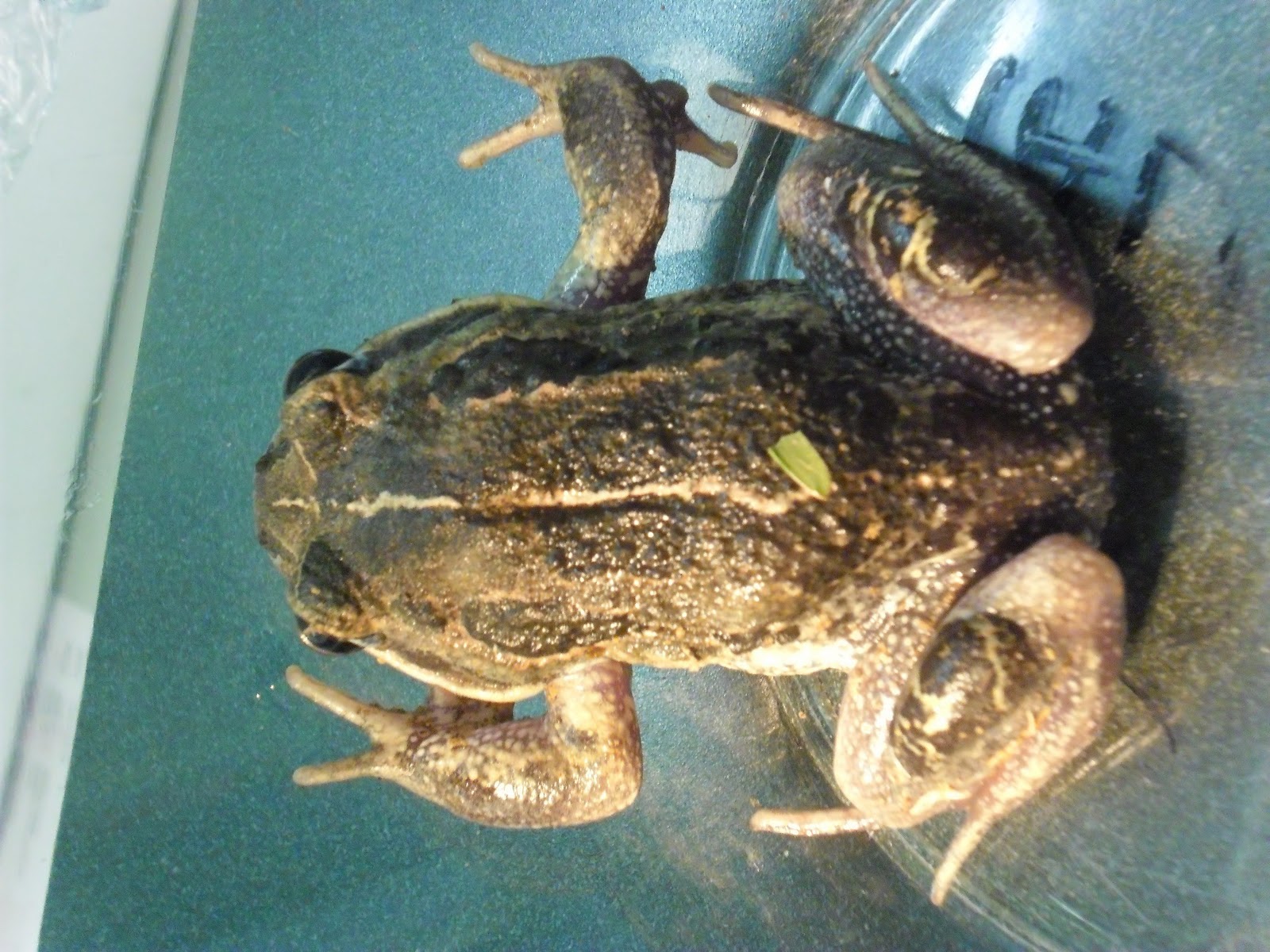
After a bit of wet weather recently, a couple of sharp-eyed residents from Quairading sent these pictures of a frog to the Shire's Environmental Officer earlier this month, concerned that it may have been an invasive Cane Toad.


Luckily it was identified as a Western Banjo, or Pobblebonk, Frog (Limnodynastes dorsalis) from the pale 'dorsal' line down the frogs back. These frog are most common in permanent and temporary water including farm dams, swamps, wetlands and streams, but can also be found in backyards across the entire south-west.


From Frog Watch Website


Western Banjo Frogs and Cane Toads  are commonly confused with each other, so if you see someting similar and you are not sure what it is, take a photo and/or report it to your local authorities so they can help with an identififaction. Your vigilance could make a difference.

In comparison, the Cane Toad (Bufo marinus) is much larger, more warty and does not have a pale 'dorsal' line down its back.

G Millen © Australian Museum
H Ehmann ©  Australian Museum

The distribution of the Cane Toad is still being resolved in Australia - the map below shows past, current and predicted range across the nation.

Distribution map for Cane Toads in Australia - note SW WA prediction

An awareness of what Cane Toads look like is one of the biggest assets our community has in the fight against this tropical invader. Although WA is almost Cane Toad free, there is a large potential for this invasive species to impact on our biological and agricultural values.

So, hats-off to the couple from Quairading who wanted to be sure their frog was not a Cane Toad - a little bit of effort can go a long way!
For more info on Wheatbelt frogs you may want to visit the Frog Watch website.

For more info Cane Toads you may want to visit the Toad Busters website.

Email info@wheatbeltnrm.org.au if you want any additional information.

Friday, November 18, 2011

Regional Landcare Facilitators going Social

During the 20011 National Regional Landcare Facilitators meeting in Melbourne this week, facilitators from across Australia explored the values of promoting the NRM/Landcare message via social media, whats going on with the Carbon Farming Initiative (CFI) and how to best engage their local communities.


In a digital world, where environmental action is becoming more sought after, one of the challenges of Landcare is getting the message out and attracting volunteers to events, both locally and from afar.

Social media may just be the key.

It was agreed that timely and appropriate use of social media (such as Place Stories) has the potential to increase the communities understanding and appreciation of Landcare activities, as well as taking local issues to the global community.

The group also got an update on the CFI from Australian Government representatives, including information on the funding available, how they relate to each other and the time frame for delivery of incentive programs.

We also ran a break-out session where small groups tried to untangle some of the barriers to successful engagement of their communities.

Overall the meeting was a great success, and a chance to discuss common issues in Landcare across the nation, get up to date info on the national Landcare program and forge new and exciting networks with other Regional Landcare Facilitators.

For more infromation on any of the above topics, email info@wheatbeltnrm.org.au

Tuesday, November 15, 2011

Regional Landcare Facilitators Meeting: 17-18th November 2011

This week Regional Landcare Facilitators from all over Australia are meeting in Melbourne to discuss national Natural Resource Management (NRM) issues and develop plans for working with communities across Australia to promote NRM in their 'backyards'


Wheatbelt NRM's Regional Landcare Facilitators Sally Sprigg (nee Raynor) and Mick Davis will be attending the two day meeting to ensure that any and all NRM issues from the wheatbelt are put on the agenda, as well as determining how our work fits in with other Regional Landcare Facilitators across the Nation.

Mick will be updating the blog to provide some info to anyone who'sd interested, so don't forget to 'follow' us so you stay up to date!

Thursday, November 3, 2011

Biodiversity Hotspots

Global biodiversity hotspots 

Australia is one of seventeen countries described as being 'megadiverse'. This group of countries has less than 10% of the global surface, but support more than 70% of the biological diversity on earth.

The concept was first developed by Russell Mittermeier in 1988, as a way to prioritise conservation action.


National biodiversity hotspots

The Australian Government announced 15 national biodiversity hotspots in October 2003. Whilst international biodiversity hotspots have been identified for some time, this was the first attempt to identify biodiversity hotspots at the national scale.

These 15 areas are examples of locations that contain particularly high levels of biodiversity under threat. 


The dominant vegetation of this area includes woodlands of Wandoo, York Gum, Salmon Gum, Casuarina and some areas of proteaceous scrub heaths. The woodlands contain many of Western Australia's threatened plants and birds. 

The area is particularly rich in endemic plants - Grevilleas, Hakeas, Eucalypts, Acacias, Eriostemons, and the Asteracea family - and invertebrates, particularly ground-dwelling spiders.
 
Most of the native vegetation has been cleared for agriculture and grazing, leading to extensive salinity problems over one-third of the area. Remnant vegetation, wetlands, river systems, populations of species and ecosystems are in poor condition, and the fragmentation of vegetation means an increased threat of weeds, fire, and feral animals.

Sedimentation, salination and other pressures such as water diversion and water pollution threaten the area's nationally important wetlands.

For detailed info on the flora and fauna of the Avon Wheatbelt IBRA Region visit the Biodiversity Programs resources page.

For more information about Biodiversity Hotspots visit this link, or contact Wheatbelt NRM on info@wheatbeltNRM.org.au

Wednesday, October 19, 2011

Bridal Creeper Control in the Avon River

A project aimed at mapping and control of Bridal Creeper (Asparagus asparagoides) and Tamarisk, both Weeds of National Significance (WONS), has begun in the Avon river. The aim of the project, funded by the Australian Government,  is to understand the distribution and abundance of these WONS and then develop an effective control program.

Greg Warburton from Wheatbelt NRM began the mapping earlier this month, and has already surveyed more tham 3km of the riverbank in Northam.


"We have plotted more than 200 occurrences of Bridal Creeper so far- and one site with Tamarisk" reported Greg.

'The focus of our efforts so far has been on mapping the Bridal Creeper while it is still lush and green from the recent rain' explained Greg. 'It dies back in summer and goes dormant, so then we'll focus on the Tamarisk'

Some early spraying has been done already.

Bridal Creeper  is a WONS because it can invade intact bushland and then smother the understory beneath its dense canopy. The resulting monoculture is hard to remove and acts as a source of propagules for new infestations.

Image courtesy of Florabase (http://florabase.dec.wa.gov.au/browse/profile/8779)

The bright red berries are spread readily by small birds.

Control of Bridal Creeper will benefit the plants and wildlife that use the waterway as a home and feeding resource, as well as many cultural sites along the river. This is a real win for the our regions namesake.

This project is specifically about controlling Bridal Creeper in the main channel of the Avon river, but anyone who wants to report an outbreak of Bridal Creeper in their area can email info@wheatbeltnrm.org.au

Blind Snakes!

A friendly kitty from Ardath, in the Lockhart sub-catchment of the Avon river, brought in an interesting critter the other day. In its mouth was a Prong-snouted Blind Snake (Ramphotyphlops bituberculatus) from the Order Squamata.

 
Natasha from Merredin says these snakes are subterranean, non venomous creatures eating ant pupae and only coming to the surface at night especially after rain. These snakes are known from WA through SA to NSW & Vic. but Ardath would be close to the limit of their western range according to KingSnake.com

With a secretive lifestyle underground, little is known about this snake or the other 42 Australian species. However, we do know they are not actually blind - their eyes are covered by scales to protect them from the ants who's mounds they raid for food.

 Thanks to Natasha and the crew from Ardath for sharing their find!

This is another example of the amazing animals which call the Avon Wheatbelt home. To find out more visit www.wheatbeltNRM.org.au or email info@wheatbeltnrm.org.au

Tuesday, October 18, 2011

Corrigin Wildflower Walk

Earlier this month, Cindy from Corrigin, with help from the Shire of Corrigin, organised a Spring Wildflower Walk near Corrigin in the central wheatbelt. More than 15 people from the local area and beyond joined in the walk, which included a visit to see the Corrigin Grevillea (Grevillea scapigera), which is in flower this time of year.


This unique and interesting low open shrub is an important species for locals to be aware of, as it only grows around the Corrigin area.


After learning more about this plant and its conservation, the group took a walk through the Corrigin Town Reserve to look at the variety of wildflowers that were on show. Many Acacia's and ephemeral annual herbs were in flower, as well as several patches of Enamel Orchids (Thymelitra spp.). A brief snack of fruit and cakes in the bush was a real treat for the kids and adults alike - then back to the wildflowers!


On the way back, several of the kids were lucky enough to see a large green Katydid - a predatory cricket-like invertebrate - sitting on some shrubs. Katydids are quite common and are found all across the south west - providing some entertaining 'songs' throughout the Spring and Summer.


For everyone involved it was a pleasant way to spend an afternoon - with good company and natural surroundings.

This casual get together was part of a plan by Cindy and the Shire to increase the communities involvement in managing the reserve. If the turn-out is any indication of the interest from the community, it likely won't be long until a local 'Friends of Corrigin Reserve' group gets going.

If you are keen to know more about this activity, be part of the Friends of Corrigin Reserve or know about similar events in the Avon, email info@wheatbeltnrm.org.au or call the WheatebltNRM office in Northam on 08 9690 2250.

Lazy Days Lizard

This 'lil fella was seen lurking about in the native plats out the front of the Wheatbelt NRM office in Northam last week!


It's a Shingleback Lizard, (Teliqua rugosa) also often called a Blue Tongue Lizard. They eat flower buds and snails, and are known to form long term bonds with their mates, like some other reptiles.

Cool days with lots of sunshine provide perfect conditions for these lizards to be found sunning themselves on roads and tracks in or near the bush, so keep an eye out when you are on the road!

Interestingly, these reptiles give birth to live young, unlike most other reptiles. Up to three young can be born from a single female!

Monday, October 3, 2011

Glorious Green Gobblers

Anyone in the wheatbelt who left their outside light on over the last few nights has likely been bombarded by large, iridescent flying beetles with rather large mandibles! They are known as Green Carab Beatles (Order: Coleoptera), Stink Beetles or Caterpillar Hunters!!


These shiny beetles have come out of the ground and begun to gather around lights across Australia, ready to meet a mate and begin the next generation of beetles. They might also enjoy a tasty moth or catrpillar as a snack if they can get one!!

Their iridescent colours are created by light that is refracted from fine grooves in their pitted carapace, which is actually black - not green!! Other species across the nation and world are various colours, including red, yellow, blue and green.


Green Carab Beetles are active at night and hunt slow-moving prey such as caterpillars. They can be beneficial as a predator of insect pests, such as armyworms and cutworms. The larvae are also carnivorous.

But, don't get too close - if you do you might get a dose of a foul smelling scent on you. They use this smell to deter predators, and it works a treat. Phew!