Wednesday, December 7, 2011

Frog Watch in Quairading

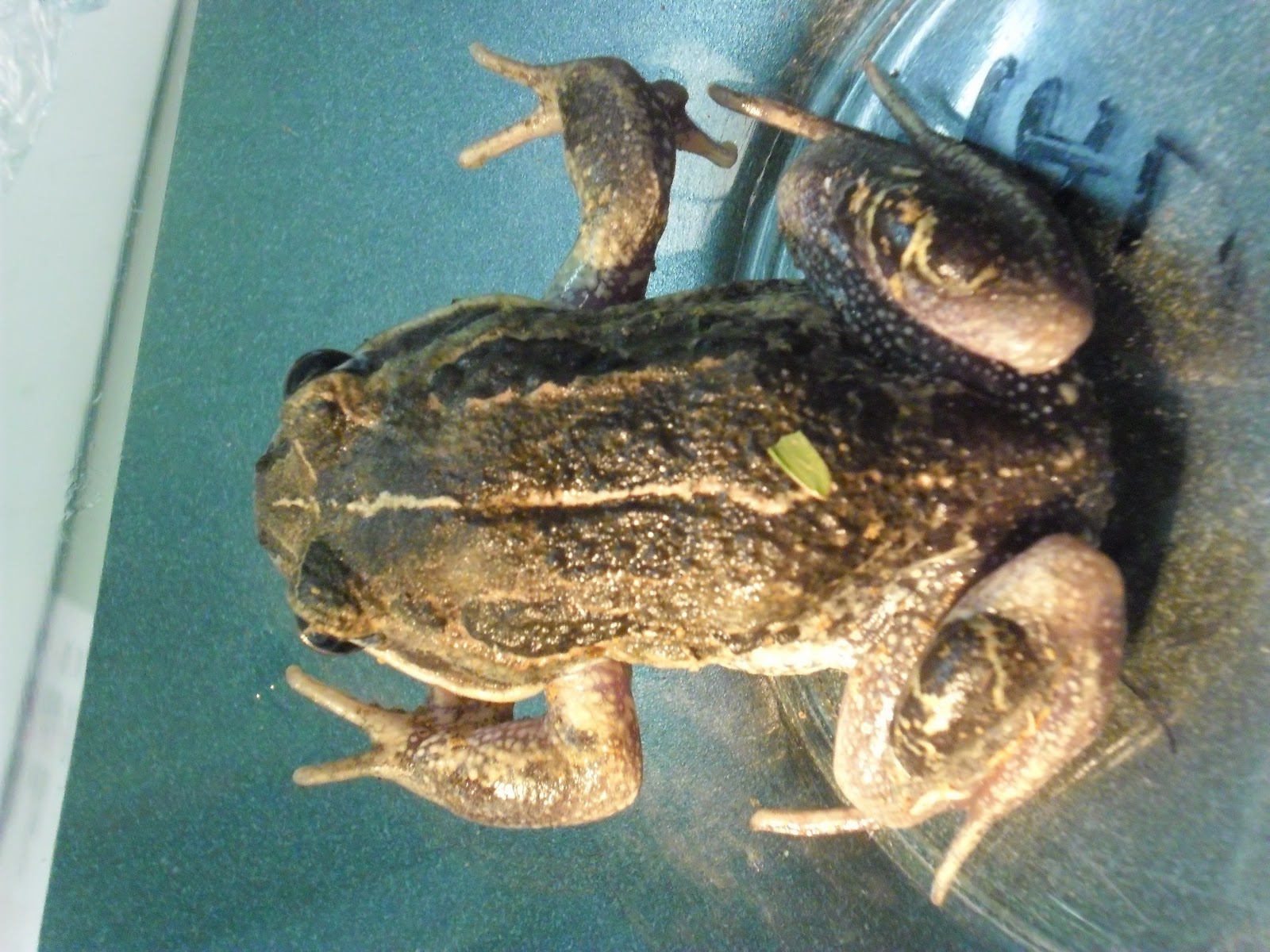
After a bit of wet weather recently, a couple of sharp-eyed residents from Quairading sent these pictures of a frog to the Shire's Environmental Officer earlier this month, concerned that it may have been an invasive Cane Toad.


Luckily it was identified as a Western Banjo, or Pobblebonk, Frog (Limnodynastes dorsalis) from the pale 'dorsal' line down the frogs back. These frog are most common in permanent and temporary water including farm dams, swamps, wetlands and streams, but can also be found in backyards across the entire south-west.


From Frog Watch Website


Western Banjo Frogs and Cane Toads  are commonly confused with each other, so if you see someting similar and you are not sure what it is, take a photo and/or report it to your local authorities so they can help with an identififaction. Your vigilance could make a difference.

In comparison, the Cane Toad (Bufo marinus) is much larger, more warty and does not have a pale 'dorsal' line down its back.

G Millen © Australian Museum
H Ehmann ©  Australian Museum

The distribution of the Cane Toad is still being resolved in Australia - the map below shows past, current and predicted range across the nation.

Distribution map for Cane Toads in Australia - note SW WA prediction

An awareness of what Cane Toads look like is one of the biggest assets our community has in the fight against this tropical invader. Although WA is almost Cane Toad free, there is a large potential for this invasive species to impact on our biological and agricultural values.

So, hats-off to the couple from Quairading who wanted to be sure their frog was not a Cane Toad - a little bit of effort can go a long way!
For more info on Wheatbelt frogs you may want to visit the Frog Watch website.

For more info Cane Toads you may want to visit the Toad Busters website.

Email info@wheatbeltnrm.org.au if you want any additional information.

Friday, November 18, 2011

Regional Landcare Facilitators going Social

During the 20011 National Regional Landcare Facilitators meeting in Melbourne this week, facilitators from across Australia explored the values of promoting the NRM/Landcare message via social media, whats going on with the Carbon Farming Initiative (CFI) and how to best engage their local communities.


In a digital world, where environmental action is becoming more sought after, one of the challenges of Landcare is getting the message out and attracting volunteers to events, both locally and from afar.

Social media may just be the key.

It was agreed that timely and appropriate use of social media (such as Place Stories) has the potential to increase the communities understanding and appreciation of Landcare activities, as well as taking local issues to the global community.

The group also got an update on the CFI from Australian Government representatives, including information on the funding available, how they relate to each other and the time frame for delivery of incentive programs.

We also ran a break-out session where small groups tried to untangle some of the barriers to successful engagement of their communities.

Overall the meeting was a great success, and a chance to discuss common issues in Landcare across the nation, get up to date info on the national Landcare program and forge new and exciting networks with other Regional Landcare Facilitators.

For more infromation on any of the above topics, email info@wheatbeltnrm.org.au

Tuesday, November 15, 2011

Regional Landcare Facilitators Meeting: 17-18th November 2011

This week Regional Landcare Facilitators from all over Australia are meeting in Melbourne to discuss national Natural Resource Management (NRM) issues and develop plans for working with communities across Australia to promote NRM in their 'backyards'


Wheatbelt NRM's Regional Landcare Facilitators Sally Sprigg (nee Raynor) and Mick Davis will be attending the two day meeting to ensure that any and all NRM issues from the wheatbelt are put on the agenda, as well as determining how our work fits in with other Regional Landcare Facilitators across the Nation.

Mick will be updating the blog to provide some info to anyone who'sd interested, so don't forget to 'follow' us so you stay up to date!